The battlefields of the Warhammer 40k universe are covered in deadly debris: tangled razorwire, broken glass windows, rubble with protruding girders, concrete tank traps, and more. Sounds just like a deathmatch wresting ring, which is why:
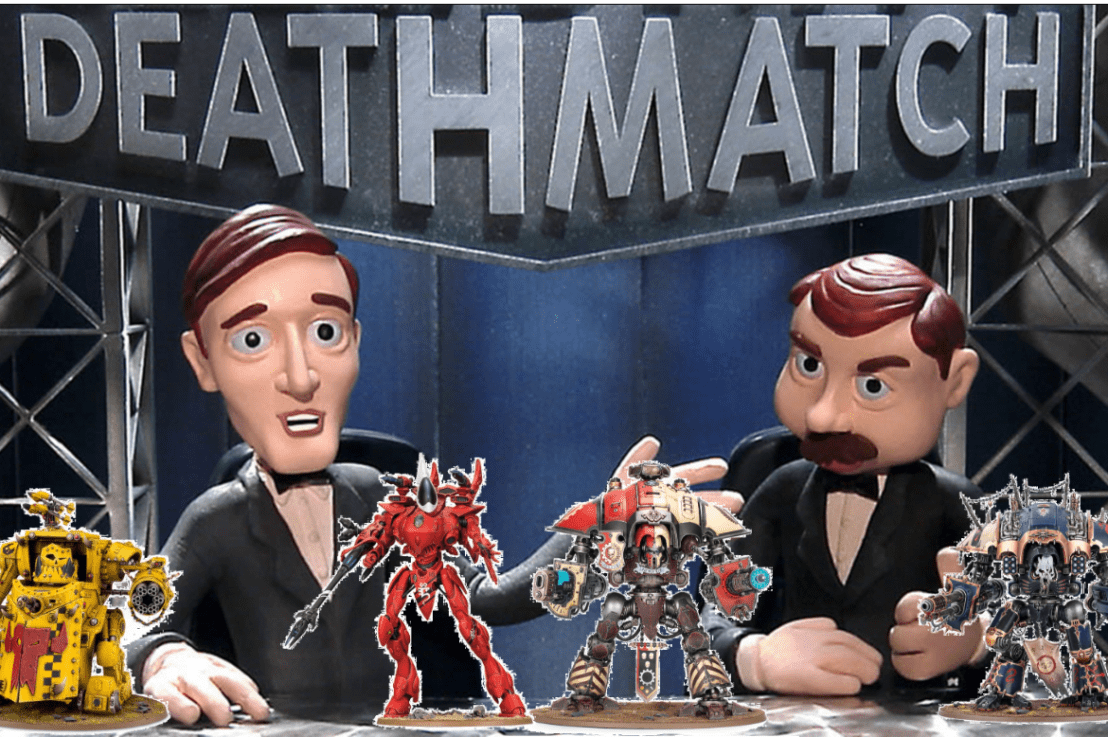
Drawbridge Games is pleased to offer our SIXTH Knight Night Fight Night event, which this time is a DEATHMATCH! It’s a night for a knock-down, drag-out slugfest with some of the largest models in the Warhammer 40k world. Plus the glory of being added to the Knight Night Fight Night trophy!
The event will take place on Thursday, May 21st, 2026. Setup at 6:30pm with first dice at 7:00pm sharp. As always we’ll have a door prize drawing, so participating is all you need to do to win!
Event Rules
This year each player will field one Knight-sized or larger model as their entrant. The goal is to be the last model standing–leaving all other competitors laying in a bloody heap–and that last standing model wins the event for their team. The rules are somewhat different this year than prior years, as deathmatch wresting events work a little bit differently. I’ll highlight the changed rules in bold so people can note them.
To start the event, each model will be placed in the ring–which will be full of all sorts of damaging terrain–starting with the highest points cost of the model downward.
Every round of combat all participant Knights in the ring are dealt a playing card, and play turns will run in that order: lowest numbers first, with suit order high-to-low in reverse-alpha to break numerical ties, so Spades > Hearts > Diamonds > Clubs, with Aces low. The active Knight will move, shoot, can charge and fight. Note that models attacked won’t swing back (there’s no ordinary combat phase). The goal is to incapacitate opposing Knight models and be the last model standing while every other model is down and presumably bleeding out. There are a few different special rules we’ll be using that will help this happen, and give Knights an outside chance to keep fighting.
Deathmatch Terrain
Part of a deathmatch is all the flourescent light bulbs, barbed wire, tables, chairs, and random objects. To represent that in this battle, terrain is hazardous and models can be thrown or knocked backward. Terrain inflicts a random number of mortal wounds based on its size, to be adjudicated at the event. Barbed wire would do 1 mortal wound, while some debris would do d3 mortal wounds, and bigger pieces of terrain doing d6 or even more! The edge of the map is considered to be a ring of barbed wire for these purposes.
Knockback and Throwing. Models hit by shooting are knocked backwards somewhat in a direct line away d6 inches. This happens once per model shooting them (so even if a model has 3 weapons, the opponent is only knocked back once). Models can also bull rush or throw their opponents by engaging in melee. Bull Rush allows models that do not have open hands/claws to knock models directly away d6 inches–they declare a charge, and roll a single to-hit roll. If they hit, the model is knocked directly away instead of suffering damage as normal (counts as a throw). Models with at least one open fist/claw can more purposefully throw their opponent. After charging they declare they are throwing, which replaces their normal melee attacks. They use their open fist(s) to toss their opponent. Roll a scatter dice. On a hit, move the thrown model the direction of the thrower’s choice for a number of inches equal to the thrower’s strength. On any other result for the scatter dice, move the model that direction and in the number of inches equal to the thrower’s strength. Thrown models stop if they collide with any objects, and take damage the moment they do.
Re-roll Chip
Every Knight gets one re-roll chip. Re-roll chips can be exchanged or traded as you wish during the game with other players. They can be spent to re-roll any one d6 roll: yours or your opponent’s. The chip can also be spent to get a one-time +2 to a roll on the Down and Bleeding chart (see below).
“Down and Bleeding” Chart
Whenever a model is reduced to 0 wounds, they get laid down on their side (if possible) or otherwise indicated that they’re out. In a multi-person deathmatch there are lots of competitors laying in the wreckage bleeding out. Most of them stay down, but on occasion one of them gets their wind back and returns to the ring. Opponents need to continue to keep them beat down to keep them from returning–and the bigger and more spectacular the hazard that takes them out, the more likely they’re out for the count.
At the end of each round, all players who have a down and bleeding model roll on the chart below. If the damage that brought a model to zero wounds was done by object damage (being thrown or knocked into something and suffering mortal wounds from it) they suffer a -1 on their Down and Bleeding rolls until they are eliminated or get a back in the action. If it’s impossible for a model to get a result of a 5 or a 6 on the chart at any point they must roll on it, then they are removed from the battlefield as if they rolled a 1.
| Roll | Result |
| 1 “It’s a bloodbath! Send in the stretcher!” | The model finally bleeds out from their damage. They are removed from the battlefield and do not take further part in the game. |
| 2 “Why are the refs not checking on him?’ | The model remains in the game but taking no part in it. |
| 3 “I see him twitching!” | The model remains in the game but taking no part in it. |
| 4 “He’s tangled in wires and glass!” | The model remains in the game but taking no part in it. |
| 5 “With so much blood it’s a wonder he could stand back up!” | The model stands up and is restored to d6 wounds. Add a cumulative -1 penalty to all future rolls on this chart. |
| 6 “He was playing possum! Surprise attack!” | The model stands up and is restored to 2d6 wounds. Add a cumulative -1 penalty to all future rolls on this chart. The model gets priority to act first in the subsequent round (it receives an Ace card before the cards are dealt) |
Painting Requirements: All models participating in Knight Night must be painted to a tabletop standard and based. Part of this hobby is, well, the hobby, so I want to encourage people to paint and get models finished for events. There will be additional chances at prizes for those who paint up a new Knight model for the event. And there will be even more additional entries in the draw for anyone who paints up “Dangerous Ruins” terrain–so you can help fill out the battlefield by painting up debris. In particular Ork-themed terrain would be perfect (and will help with the summer events coming up too!).
Knight Options and Choices
Knight Options: Players can choose any non-character Knight from the Imperial Knights or Chaos Knights codex with gear allowable from the data sheet (no relics or warlord traits). No army rules, detachment rules, or upgrades that aren’t part of the basic datasheet entry for the Knight will be used. These are vanilla versions of the data sheets folks.
When is a Knight not a Knight: We’re not able to allow in every Xenos and Chaos faction, but applications to field other types are allowable if they’re comparable in stature to a Knight or larger model (note they may not be comparable in points).
- Stormsurge
- Wraithknight
- Gorkanaut
- Morkanaut
- Stompa
- Lord of Skulls
- Seraptek Heavy Construct
- Warhound Titan
- Reaver Titan
- Warlord Titan
- Revenant Titan
- Phantom Titan
- Hierophant Bio-Titan
- Ta’unar Supremacy Armor

